A Winter Descent Gone Wrong: How an Ordinary Rural Road in the U.S. Turned Into a Sliding Trap of Ice and Chaos
Winter does not always announce itself loudly. Sometimes it arrives quietly — a subtle drop in temperature, a thin layer of evening rain, and by morning the world transforms into something far more unpredictable. That was the setting in this fictional yet strikingly realistic scenario: a rural magistral road somewhere in the United States, not a major highway with constant monitoring, but a simple two-lane descent cutting through hills, trees, and quiet countryside. It was the kind of road drivers pass daily without a second thought.
On this particular day, however, everything changed the moment the road froze.
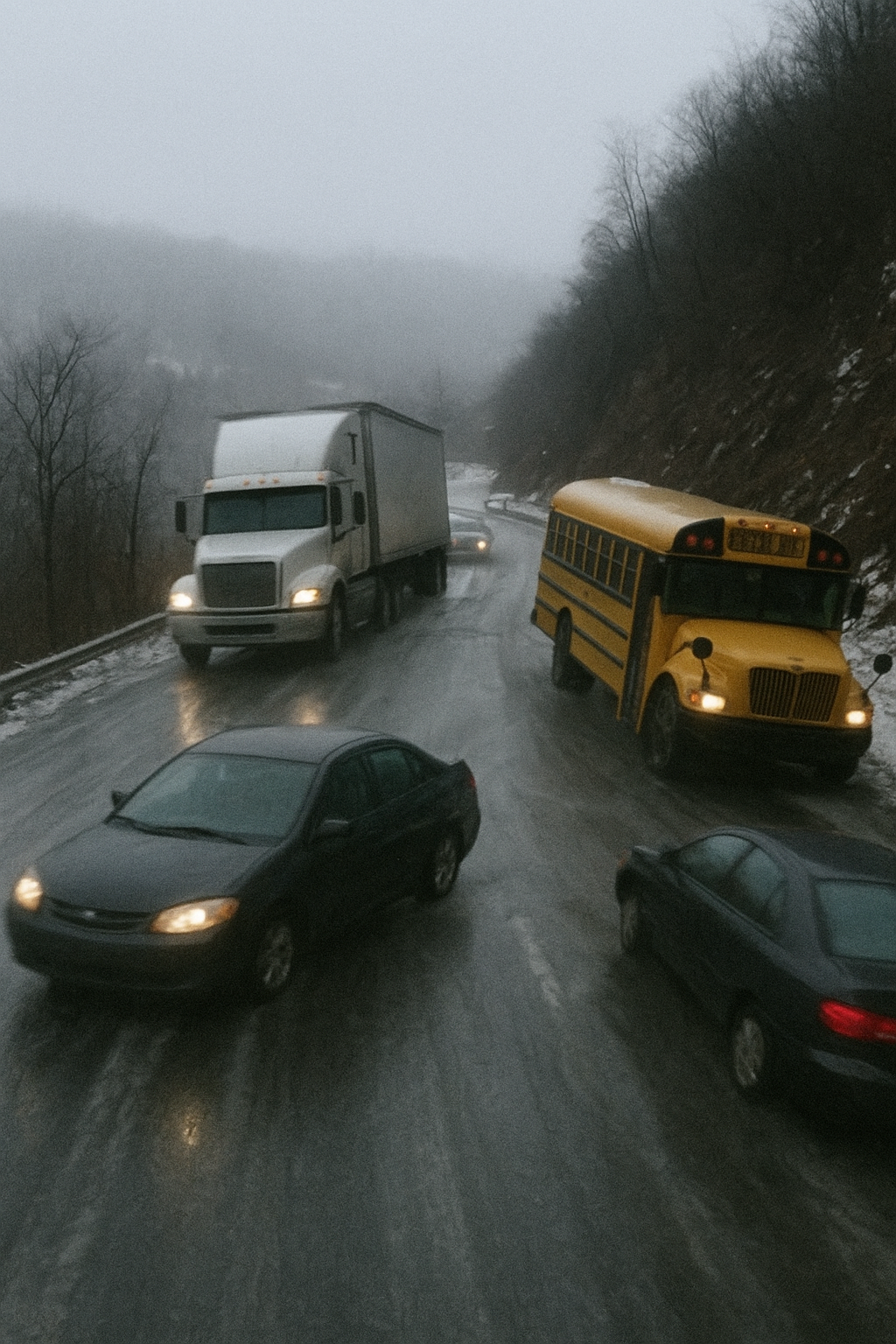
What followed wasn’t a high-impact explosion-filled event as seen in movies — instead, it was slow, terrifying inevitability. A series of vehicles — two cars, a semi-truck, and a school bus — descended the hill unaware that the ground beneath them had turned into a polished mirror of ice. No engine power, no braking force, no steering skill could fight what nature had created overnight.
This article takes you through the moment — step by step — with detail, atmosphere, human perspective, and a reminder of how fragile control truly is when winter takes over.
The Morning Atmosphere: Silent, Cold, and Deceptively Calm
The sky carried a gray weight, the type of cloud cover that promises silence more than snow. Fog draped itself over distant hills like a blanket. Bare trees stood still like cold skeletons reaching upward, motionless, waiting.
The road surface looked wet rather than icy — the most dangerous kind of ice — often called black ice. It hides in plain sight. Anyone driving on it thinks the asphalt is only damp. Tires roll without squeal. Everything seems normal until the moment it’s not.
To the right side of the road, snow had gathered beside a sloped hill, pushed aside by plows days before. On the left, the land dipped downward into a shallow ravine, partly covered by brush and leafless branches. A metal guardrail stretched along certain segments, but not everywhere. It was the kind of rural engineering common in the countryside — enough to guide, but not enough to guarantee safety.
The First Car Notices Too Late
The first vehicle — a dark compact sedan — approached the downhill stretch at a moderate speed. The driver likely thought about work, errands, family, or nothing at all. Perhaps they had driven this road hundreds of times. Familiarity creates confidence, and confidence creates vulnerability.
At the top of the descent, the driver tapped the brakes — gently, as anyone would — but instead of slowing, the tires lost their voice. There was no bite, no grip. The car continued forward, gliding silently like it was floating. In seconds, steering meant almost nothing. The vehicle drifted sideways, the rear end swinging unpredictably. The driver fought the wheel, heart pounding, realizing instantly that control was gone.
Gravity took over. The car was no longer driving — it was being carried.
The Second Vehicle Follows, Unaware of the Invisible Risk Ahead
Seconds later, another car appeared in the distance — perhaps a local resident or someone simply passing through. They noticed the first car up ahead but expected it to be slowing normally. They pressed the brakes — and the exact same response unfolded. The vehicle slid forward as if on oiled glass.
With both cars now moving downward without traction, the situation shifted from personal panic to collective danger. One car spinning on ice is bad. Two cars sliding toward each other is worse. Neither driver had the luxury of stopping. They were passengers inside moving metal uncontrolled by their hands.
Then Came the Truck — Large, Heavy, and Almost Impossible to Stop
A semi-truck appeared at the top of the hill, tall and dominant, its headlights cutting through winter fog. Trucks carry momentum differently — once moving downhill, they are like giants of physics. Even when a driver notices ice, reaction time is limited and mass becomes the enemy.
The truck driver likely attempted to brake early, pumping the pedal, downshifting, doing everything years of experience taught. But the road offered no deal. Thousands of kilograms of steel began sliding, slow but unstoppable, its tires gliding across the frozen surface without a single sound. The truck inched closer to the cars below, unable to stop, like a slow-motion nightmare.
The tension builds not from speed — but from inevitability.
The School Bus Appears — A Sight That Tightens Every Viewer’s Chest
Perhaps the most emotionally impactful moment in this recreated accident scene is the arrival of the yellow school bus. We are conditioned to associate school buses with children, safety, and routine. Even if empty, the sight of a bus losing control sparks a primal reaction in anyone watching.
The bus approached the slope slightly angled, tires attempting to grip but failing. It began sliding sideways, front end drifting toward the center of the road. The bus and truck moved slowly but with unstoppable mass — heavy, deliberate, dangerous.
Suddenly, four vehicles shared one icy downhill path — none capable of stopping themselves or the others.
It feels like watching time stretch, every second heavier than the one before.
Details That Make the Scene Feel Real
Part of what makes this scenario powerful is the realism. The lighting is dull and natural, the video-style perspective reminiscent of dashboard footage or a roadside security camera. No cinematic filter. No bright clarity. The image is slightly grainy, imperfect — exactly how real winter footage tends to look.
Reflections shimmer on the ice. Mist softens the background. Tire marks streak across the frozen road, thin and fragile. Snow lies untouched along the shoulder, not glamorous, just cold and present. The vehicles are not perfectly spaced like a staged scene — instead they are staggered unpredictably, tilted, caught mid-slide in different directions.
You can almost feel the cold through the screen.
You can almost hear the quiet panic.
The Physics of Ice and Why Drivers Lose Control So Quickly
Black ice forms when rain or melting snow refreezes on road surfaces, creating a thin transparent layer. It is nearly invisible and extremely slippery. Even modern vehicles with ABS, traction control, or winter driving modes struggle against it.
On icy downhill roads:
- Braking increases sliding rather than stopping.
- Steering can cause skidding instead of directional correction.
- Vehicles lose friction, meaning gravity dictates movement.
- Heavier vehicles like trucks and buses stop last, not first.
Once a vehicle loses grip, it behaves less like a controlled machine and more like a sled.
How Such Incidents Can Be Prevented in Real Life
Although this article reconstructs a fictional scenario, the lesson behind it is valuable. Winter roads demand respect, especially in rural areas where treatment is inconsistent.
Best safety practices for icy descents:
- Reduce speed long before the slope begins
- Use snow tires or chains in severe winter zones
- Avoid braking suddenly — brake gradually and early
- Increase following distance significantly
- Stay alert for temperature drops near dawn and dusk
- Check weather and road condition reports before traveling
Preparedness is not paranoia — it’s responsibility.
Human Reaction in Such Scenarios
Imagine being inside one of those vehicles. The sensation is surreal — the world moves, your vehicle moves, yet your ability to influence it disappears. Some hold their breath. Others whisper prayers. Some simply freeze, gripping the wheel even though it no longer matters.
In the truck, the driver likely watches the scene ahead with dread, knowing the weight behind them is now a threat instead of stability. Inside the bus, perhaps seats rattle softly, windows vibrate, and the feeling of mass slipping is unmistakable.
The scariest part is the silence — no screeching tires, no roaring engines — just the soft hum of sliding rubber.
Winter teaches humility.
Why Scenes Like This Fascinate Online Viewers
People are drawn to situations that feel real. Not exaggerated disasters, but relatable moments when ordinary life flips unexpectedly. A simple road. A normal day. A few vehicles. And one hidden patch of ice that changes everything.
Videos and imagery like this are often shared for:
- Awareness and education
- Seasonal safety reminders
- Road condition discussions
- News-style storytelling
- Realistic accident recreations
It sparks a universal thought:
“What if that were me?”
Conclusion
A calm winter morning turned dangerous in seconds. A rural American road became a runway of ice where vehicles had no control over their fate. Cars slid sideways, a truck descended like a slow metallic avalanche, and a school bus joined the silent chaos — all moving not by engine, but by gravity.
This story, though fictional, reflects real scenarios that happen every winter around the world. It reminds us that weather deserves respect. Ice is invisible but unforgiving. Every driver, whether in a compact sedan or behind the wheel of a massive truck, is vulnerable when nature decides to take command.
Stay cautious. Drive slow. Know that winter roads are never as innocent as they seem.